
September 15, 2025
RSL and the Economy After Jobs
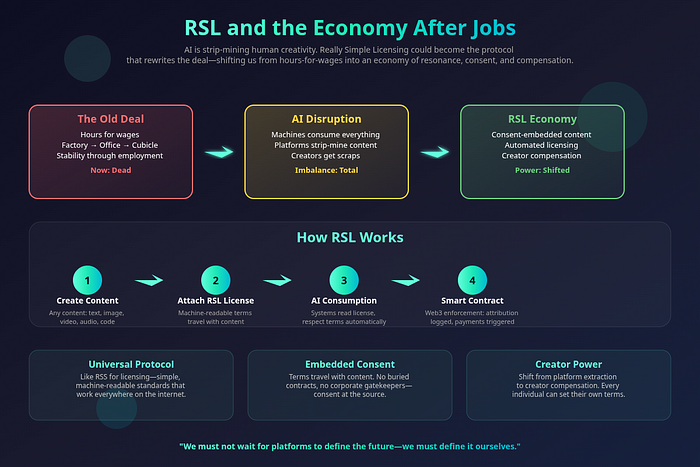
AI is strip-mining human creativity. Really Simple Licensing could become the protocol that rewrites the deal — shifting us from hours-for-wages into an economy of resonance, consent, and compensation.
The Old Deal is Dead
For more than a century, the trade was simple: hours for wages. You showed up at the factory, the office, the cubicle, and you sold your time. In return, you got money and, if you were lucky, stability.
But the deal was already unraveling long before AI arrived. Gig work eroded stability, corporations automated wherever they could, and “do more with less” became the mantra of every industry.
Now AI has blown the whole thing apart. Machines don’t just automate; they consume. They scrape blogs, ingest art, swallow music, and train on code. Every keystroke, every story, every song becomes raw material — and the platforms built on this extraction grow fat while creators are left with scraps.
Enter RSL: A Protocol for Consent
This is where Really Simple Licensing (RSL) steps in. Think of it like RSS, the protocol that quietly rewired the internet two decades ago by making syndication simple and universal.
RSL does the same for licensing. It attaches a clear, machine-readable license to any piece of content — text, image, video, audio — so that AI systems know, without ambiguity, how that content can be used.
It’s not buried in a contract, not locked in a corporate API. It’s at the source. You create something, you tag it with RSL, and the rules travel with the content wherever it goes. Consent, embedded in the fabric of the web.
Why Timing Is Everything
Copyright and Creative Commons provided guardrails for human readers and human publishers. But the AI age doesn’t operate in human time. Machines consume billions of documents overnight. They don’t ask, they don’t pause, they don’t even acknowledge.
Without RSL, the imbalance is total: platforms strip-mine at machine speed, while creators negotiate at human speed. With RSL, the balance shifts. Licensing becomes just as fast and automated as ingestion. For the first time, humans can set terms in the same language that machines consume.
Web3 as the Enforcement Layer
Licenses alone aren’t enough. Rules without enforcement are just wishes. This is where Web3 comes in — not as a buzzword, but as infrastructure.
An RSL license can point to a smart contract, a self-executing agreement that lives on a blockchain. When an AI consumes your work, the contract fires automatically: attribution is logged, micropayments are triggered, rights are respected.
No lawyers, no middlemen, no “trust us” from platforms. The rules are the code.
Life After Jobs: The RSL Economy
What comes after jobs? It won’t be nothing. It will be something stranger, more distributed, less linear than we’ve ever imagined.
We’re already seeing the outlines in the corners of YouTube and TikTok: people carving soap, brushing microphones, cleaning rugs, detailing cars. On the surface, it looks like entertainment or ASMR. But there’s something deeper happening. These aren’t just videos for people; they are raw material for machines. Every camera angle, every brush stroke, every gesture is reference data.
Think about it: the janitor, the electrician, the mechanic — all can point a phone at their work and generate not only a tutorial for other humans, but training data for AI. The RSL economy turns this into a loop of value. Instead of platforms strip-mining the footage, every recording, every caption, every step can carry a license: “This is mine. You may use it, but here are the terms.”
It doesn’t have to be glamorous, it doesn’t even have to appeal directly to people. A video of rug-cleaning may never go viral, but to an AI learning about texture, motion, and transformation, it’s priceless.
This means new “professions” will emerge in niches we can barely imagine. Farmers documenting soil prep. Teachers annotating lessons. Someone narrating their grocery run. In the RSL economy, resonance and specificity become currency. The more unique your lens, the more valuable your output — not because a manager says so, but because the ecosystem of machines and humans continues to learn from it.
This is life after jobs: not the end of human work, but its reorientation. Away from cubicles, away from timecards, into a world where the smallest act, when recorded and licensed, becomes part of the collective training set.
The Shadows on the Wall
No new system is free of risks. Spam will flood the ecosystem. Low-quality content will try to game the licensing. Visibility will remain concentrated — famous voices will still echo louder than quiet ones. Corporations may resist, preferring to keep the strip-mine open.
And there’s the danger that RSL simply recreates the influencer treadmill, another race for clicks and visibility, dressed up as fairness.
But these shadows don’t erase the need. They only remind us that vigilance will be necessary. The point of RSL isn’t utopia. It’s leverage.
Building Anyway
Perfection isn’t the point. The old deal wasn’t perfect either. What matters is whether creators have a seat at the table when the new economy forms.
RSL offers that. It gives individuals — from soap carvers to software engineers — the ability to set their own terms in a machine-readable world. It shifts power, even if imperfectly, away from platforms and toward people.
Once the protocol exists, it can be iterated, refined, extended. The important thing is to build it, use it, and refuse to let silence be the default license.
The Call
The cubicle is gone. The old deal is gone. AI has rewritten the rules whether we like it or not. The question isn’t whether a new economy will emerge — it’s who will define it.
Really Simple Licensing isn’t just a protocol. It’s a philosophy: consent baked into code, respect embedded in the network, compensation aligned with creation. The alternative is simple: more strip-mining, more scraps, more betrayal.
The call is this: we must not wait for platforms to define the future. We must define it ourselves.